
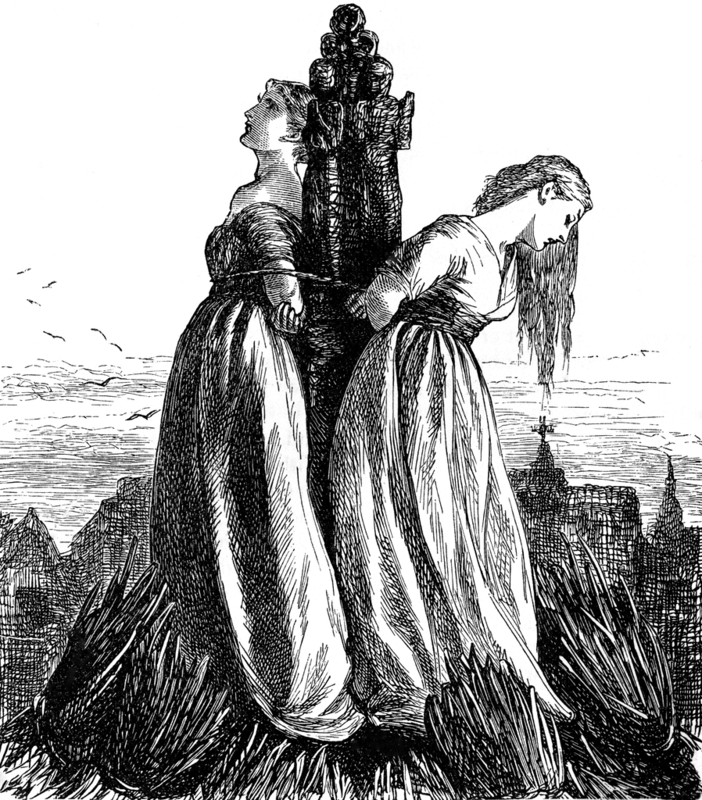
Bridget Bishop was hanged in Salem in 1692 after being accused of witchcraft. Her death marked the start of the 15-month-long period of hysteria known as the Salem witch trials.
Salem was a Puritan village struggling to overcome the aftermath of King Philip’s War and a smallpox epidemic. On top of this, the community feared the surrounding Native American tribes and feuded with the neighboring Salem Town. Salem consisted of poor farmers and traders who lived by a strict Puritan culture. The Puritan culture believed that God and the Devil were a constant part of daily life and viewed their hardships as acts directly from the Devil.
In January of 1692, young girls throughout the village began to show signs of ‘bewitchment’ through fits of violent contortions and screaming outbursts. The daughter and niece of minister Samuel Parris accused Tituba, their slave, of bewitching them. Tituba, along with Sara Good and Sarah Osbourne, were questioned in front of magistrates Jonathan Corwin and John Hathorne. While Good and Osbourne pleaded innocent, Tituba confessed and admitted other witches worked alongside her in Salem. Panic spread rapidly.
As this fear spread, accusations rose, three-quarters of which were directed at women. The judicial system in Salem was taken over by the witch trials. More than 200 people were accused: 30 were found guilty, 19 were hanged, 1 was pressed to death with heavy stones, and at least 5 of the accused died due to the conditions of the prison.
In May of 1692, Cotton Maher, a respected magistrate, expressed doubt toward the allegations. As people began to slowly question the legitimacy of witchcraft, the intensity of the witch trials diminished. By early 1693, all people accused of witchcraft were released from prison, and the Massachusetts General Court declared a day of fasting to acknowledge the tragedy of the Salem Witch Trials. A memorial for the victims was built in 1992 near the Salem Witch Museum in Salem, Massachusetts.
The Salem witch trials are a painful truth that shows how the strict religious culture, social divide, economic hardships, and the targeting of outsiders can make neighbors turn on each other.
Info source: https://www.britannica.com/event/Salem-witch-trials and https://billofrightsinstitute.org/essays/the-salem-witch-trials/
Photo source: https://etc.usf.edu/clipart/186700/186758/186758-two-women-about-to-be-burned-at.htm