
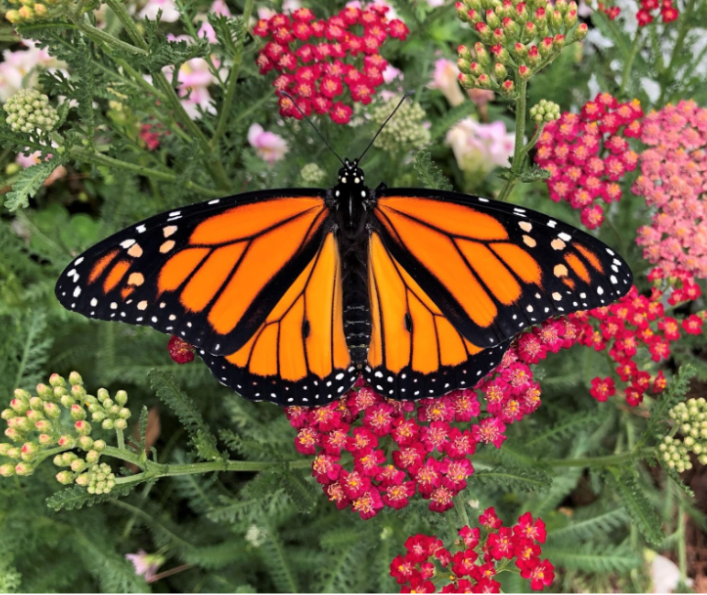
Photo credit: Sarah Rayner
Through our rapidly changing society, scientists make new discoveries everyday. Recently, scientists have refined knowledge and insight of climate change's effects on the monarch butterfly. With its deep orange color and black outline with white spots that glisten in the sun, it's no shock these insects have become a fan favorite. The facts, however, deems these species in grave danger. Monarchs, like many other animals, migrate every fall from Canada and the United States, to find comforting warmth in sunny Mexico. Their migration assures that they stay warm during the winter and cool during the summer. The monarch species are not directly threatened by climate change, however, their migration behavior will become altered dramatically. Mexico’s ideal area for settlement is pushing further south which lengthens the monarch's already long and treacherous journey. With this being said, monarchs are starting to remain stagnant, avoiding a trip back to their northern breeding grounds. This is due to their main food source, milkweed, dwindling in the North. In addition to a limited food source, Erin Garcia de Jesús states, “Habitat loss, extreme weather, pesticides and parasites are among the reasons fewer insects reach their winter home.” With all of these combined factors, some monarch butterflies will continue their long standing tradition, while others are steering clear of their long migration and are staying put in Mexico.
Many people have tried to defy aging, and unsurprisingly, have failed. However, new research seems to show that sharks have cracked the code. Scientists have discovered that sharks’ organs may be resistant to the ravages of age, while others seem resilient to tissue damage that accrues over time. These findings show how sharks seem to live longer than all other vertebrates on Earth. Lily Fogg, a biologist at the University of Basel in Switzerland, says the ultimate goal is to use these findings to treat aging organs in people. Scientists’ research of Greenland sharks also showed shocking results. Physiologist Alessandro Cellerino and his colleagues stated that the Greenland shark’s genome pointed to enhanced DNA repair function in their eyeballs, but may be in their other organs as well. Additionally, scarring and other damage in the shark’s heart, which in humans would be a sign of cardiovascular disease, does not seem to harm their health. Scientists speculate that this is due to shark’s tissues producing hormones that protect the heart from aging. Although these discoveries have no immediate applications to human health, individuals are staying hopeful that this will be the key to eternal youth.
Work Cited:
-https://www.sciencenews.org/article/monarch-butterfly-migration-climate
-https://www.sciencenews.org/article/greenland-sharks-aging-heart-eyes
-https://blog.nwf.org/2023/09/monarch-butterfly-identification-guide/