
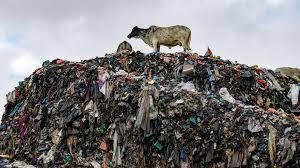
As an estimate, the fast fashion industry results in 10% of global carbon emissions annually, which is more than the emissions from international flights and maritime shipping combined, making it the third largest polluter in the world. (earth.org.) Fast fashion is defined as rapidly produced, mass-marketed textiles in response to fast-moving trends. Because of its momentary nature of production and marketing, most of it ends up in landfills in less than a year.
Fast fashion is an issue for a number of reasons. Foremost in my mind, the fact that most of these companies abuse and underpay employees. From uniformmarket, “Workers in the fast fashion industry are paid as little as $1.58 per hour. The U.S. Department of Labour found that 80% of contractors were breaking laws on minimum wage and overtime pay. They recovered over $892,000 in unpaid wages and damages. They caught one contractor paying garment workers only $1.58 per hour in a state where the minimum wage was $15 per hour.” Child labour is also blatantly employed in these industries. “Globally[,] there are 151.6 million children aged between five and 17 years in child labour. Half of these children are in hazardous work[,] including in fashion supply chains.” (commonobjective.co)
Not only that, but the clothes being bought from these companies, mainly the infamous overseas retailer Shien, which makes up 50% of the market share, is worn on average only 7-10 times before being thrown away. This is a decline of more than 35% in just 15 years. Additionally, the sector consumes enough water annually to meet the needs of 5 million people, and “35% of microplastics in the ocean are from the materials used to produce fast fashion. A typical polyester can keep on shedding microplastics for over 100 years before it degrades.” (uniformmarket) Even if you avoid Shien, buying from Amazon also becomes less sustainable every day as Amazon is made up of individual resellers frequently selling Shien or Temu items, or fast fashion companies like Shien directly selling items under several fake business names.
If you're unconvinced through child-labour statistics or the quick "use and throw" attitude of Shien's design, a few rapid-fire statistics also include things like “Fast fashion consumes 1.35% of the world’s oil”, “Over 11.3 megatons of textile waste ends up in US landfills every year”, and “24% of the world’s biggest fashion brands disclose nothing on decarbonisation.” (uniformmarket)
So why do people open these pages, let alone spend money on ill-created textiles that they will wear maybe eight times, and in the process, support what is often child labour and almost certainly underpaid labour? Money, right? After all, about 696 million people still live in extreme poverty worldwide (worldpopulationreview.com), about 50 million Americans have household incomes below 125% of the poverty threshold (https://justicegap.lsc.gov/), and fast fashion is, if nothing else, typically cheap. Actually, the highest consumers of fast fashion industries are the richest countries, and the richer citizens are buying and throwing away far more than lower-income individuals. “People with higher incomes generate, on average, 76% more clothing waste than people with lower incomes.” Ouch! Not only that, the largest users of fast fashion are the upcoming generation, my own. “It’s safe to say that Gen Z is a hypocrite in the fast fashion case[.] [An] SHU study uncovered a paradox among Gen Z fashion consumers, 94% of respondents said they support sustainable clothing[,] but surprisingly 17% of them shopped at a fast fashion retailer every week, and 62% did so monthly.” (uniformmarket). Gen Z individuals spend $767 on average every year buying fast fashion.
Evidently, there seems to be a desire for sustainable clothing, but not effort. The idea that your money, if thrown into a large enough pot, makes no difference, even if said pot is contributing directly to poverty and greatly damaging our environment, is a myth. We need to stop buying from these slave-and-child-labour dependent slop companies and start somewhere else.
Maybe, if common retail non-fast fashion stores are too expensive, thrift stores could be helpful. Not only is this inexpensive, but it helps increase the lifespan of a single garment, preventing it from ending up in the landfills or oceans. If common chains or local stores are within your budget, you could spend your money supporting a small business rather than uncompensated factory injuries. The fast fashion industry wants us to think that sustainability is expensive, impossible, unfashionable. By promoting ideas like “outfit repeaters” (a term denoted to people who wear an outfit more than once), the myth of fast fashion being the only way to “keep up” is perpetuated. However, ethics and morality will always come before the latest trends. In addition, many "new" trends end up recycling trends from decades before, which means keeping your old garments could help you be at the forefront of new style trends. Regardless, fast fashion is damaging, cruel, poorly made, and on the rise. Put your money where your mouth is, and stop buying from these companies.
If you start with a well-made item, you won't have to replace it for ages, and it’s simply a lie that you have to keep up with consumerist trends by throwing out the old and buying the new. In my next article in this two-part series, I’ll give you examples, demonstrative images, and advice on how to fix, patch, and update your closet without buying unnecessary new garments, and hopefully gain a hobby in the process.
Sources: https://worldpopulationreview.com/country-rankings/poverty-rate-by-country
https://justicegap.lsc.gov/resource/section-2-todays-low-income-america/
https://earth.org/fast-fashion-and-emissions-whats-the-link/
https://www.uniformmarket.com/statistics/fast-fashion-statistics
https://www.commonobjective.co/article/child-labour-in-the-fashion-industry